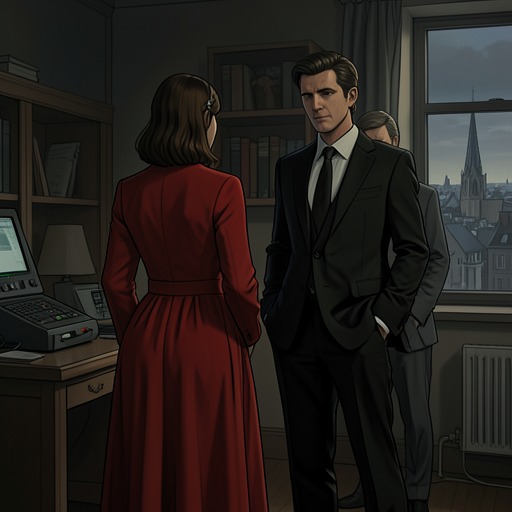
Brian Friel
Say NothingBrian Friel was an Irish playwright whose work examined how political conflict is shaped by misperception, historical memory, and language. The Freedom of the City placed the mistaken identification of peaceful civil-rights protesters at the centre of a tragedy; Field Day, the theatre company he co-founded with Stephen Rea, later made the staging and circulation of Irish stories a deliberate cultural project. Across these works, the stage offered a way to confront division without simply repeating its political slogans.
The Freedom of the City and the London bombing
On the night before the London bombing, Dolours Price and Marian Price went to see Friel’s new play, The Freedom of the City, at the Royal Court. Hugh Feeney joined them after arriving late because he had made a final check on the car bombs. The juxtaposition was stark: the group spent the evening at the theatre while preparing an attack, and Feeney understood the performance as perhaps the last good theatre they might see for some time. The play was not a diversion from the political world that had brought them to London. Its subject made that world newly visible.
The drama follows three civil-rights protesters who take refuge from gas and rubber bullets inside the Guildhall, Derry. Outside, the press and the British Army come to believe that the peaceful marchers are terrorists occupying the building by force. The misunderstanding turns the protesters into targets: British troops shoot them, and a tribunal subsequently declares the shooting justified. The movement from refuge to supposed armed occupation, and then from killing to official vindication, gives the play its political force. Violence is not presented as the inevitable result of what the protesters do; it grows out of the story others tell about them.
The Guildhall also carries a history beyond the play’s immediate action. It was the place where Ian Paisley and Major Bunting had whipped up their followers on the eve of the ambush at Burntollet Bridge. Friel’s fictional protesters are therefore enclosed in a building already associated with political agitation, while the people outside impose an armed meaning on their peaceful presence. The play, inspired in part by Bloody Sunday, which Friel had witnessed, addresses the hysteria, mythmaking, and misunderstanding that helped turn a peaceful civil-rights movement into violent conflict. Its tribunal echoes the cover-up after Bloody Sunday: an inquiry follows the deaths but confirms the official justification for them.
Reception and connection to Stephen Rea
The London production met a sparse and uneasy audience. Stephen Rea, one of its three leads, later described its reception as a frost of ignorance. Rea was himself from Belfast and had met Dolours Price through the civil-rights movement in the late 1960s, before their lives diverged: she joined the Provisional IRA, while he became an actor in Dublin and Edinburgh and then joined the Royal Court company. On the eve of the bombing, Price watched him play a marcher mistaken for an IRA member. The connection between stage and street was unusually close, but not identical: the play showed the fatal consequences of misidentification, while the people watching it were themselves preparing a bombing.
Friel’s work thus reached Price through a performance shaped by Rea’s presence and by a story that resonated with the political history she knew. That resonance does not make the play an endorsement of the bombers’ actions. Rather, it places their choices beside a drama about the destructive consequences of turning peaceful protest into an imagined terrorist threat. The audience’s reported unease and the play’s poor reception in London also sharpen the contrast between the work’s political subject and the difficulty of getting that subject heard.
Field Day and the politics of language
Friel and Rea renewed their artistic connection through Field Day, which they co-founded in 1980. The company began with the world premiere of Friel’s Translations, set in a school in Donegal in 1833. Its subject was a British Army survey that identified local Irish place names and replaced them with English translations or phonetic equivalents. Language in the play is not merely a means of communication: the survey makes naming part of the encounter between British authority and Irish place, showing how a landscape can be recast through the words used to describe it.
The choice of venue gave that concern a pointed setting. Translations opened at the Guildhall, Derry, a symbol of unionism and a frequent IRA target. Scaffolding still covered parts of the building as workmen repaired damage from earlier attacks. The venue therefore held both the immediate evidence of conflict and the possibility of a different use for a contested civic space. Its choice could seem arch, but also hopeful: a play attentive to the politics of naming was staged in a building marked by the political divisions it sought to examine.
A shared stage across a divided country
Friel and Rea intended Field Day to produce one play each year and tour it around Ireland. Its participants and supporters included the poets Seamus Deane and Seamus Heaney. The company’s politics were disputed: some regarded it as a nationalist outfit, and one critic called it the cultural wing of the Provos. Yet Friel’s plays could be political without stating a party position directly, and Rea resisted being placed in an ideological camp. He described Field Day’s activity as political in the broadest sense, connecting its purpose to the possibility that people on both sides of a divided country might hear the same story and find some shared ground in it.
The company’s board had three Catholic and three Protestant members, all described as lapsed, but no unionist. That composition makes clear both the effort to cross a religious divide and the limits of the company’s representative reach. Its practical method was less abstract: Field Day toured for months each year, taking professional theatre into parts of Ireland that had not seen a professional company for thirty years. Dolours Price often travelled with Rea after their marriage, helping manage the books and correspondence, recording mileage and petrol costs, and taking the car to the garage. In rural places, farmers arrived by tractor and walked over to makeshift stages. The touring work turned the idea of a shared story into a physical encounter between a company and audiences far from established theatre circuits. For Friel, the stage could not undo political division, but it could carry language and stories across it.